


More Than a Game: How Soccer Builds Girls’ Mental Health
EVIDENCE TO ACTION | Science Made Simple World Cup Edition | The State of Women Institute
By Dr. Odessa Lacsina, Executive Director, The State of Women Institute
Spain won the 2026 FIFA World Cup earlier this week. A goal in extra time. 70,000 people watched in New Jersey, and millions more watched from living rooms, bars, and phones held up in streets across the world.
Somewhere in all of that, a girl decided she wanted to play.
Research already knows what happens next — and it has nothing to do with whether she ever scores a goal.
What the Research Shows
Research published in Systematic Reviews in March pulled together 189 studies on sport and youth mental health. Team sports showed stronger and more consistent mental health benefits than individual sports across every measure: self-esteem, life satisfaction, lower depression, lower anxiety. The mechanism was not competition or achievement. It was belonging, self-perception, and social support.¹
A separate study from RMIT University, conducted in partnership with VicHealth, tracked girls aged 11 to 17 across a full soccer season. Girls who reported a stronger sense of belonging to their team had lower anxiety, stronger peer relationships, and higher levels of life satisfaction and purpose. They described their teammates as a second family. Not a team. A family.²
Why Girls Leave — and Why it Matters
This matters because girls leave sport.
Girls drop out of organized athletics at roughly twice the rate of boys during adolescence — right at the window where the mental health benefits are most protective. The reasons are layered: body image pressure, fewer visible role models, less investment in girls' programs, and coaching cultures that were not built with them in mind.
But the RMIT study pointed to something specific. Belonging was the protective factor. When girls felt they had a place on a team, the benefits held. When that sense eroded, so did the outcomes.²
Representation and Access
Girls watching this tournament are growing up in an era when women's soccer has a visibility it simply didn't have a generation ago. Research shows that girls who see themselves reflected in elite sport are more likely to participate — and participation is doing something measurable in how they feel about themselves and their lives.
But access to organized team sport is not evenly distributed. Girls in under-resourced communities are less likely to have structured programs, safe fields, affordable registration, or coaches trained in adolescent wellbeing. The mental health benefits the research describes do not reach them automatically.
Today was a good day for soccer. The science suggests it could also be a good day to ask which girls in your community have a team to belong to — and which ones don't.
Sources
¹ Khan et al. "Sport and youth mental health: a systematic review." Systematic Reviews, March 2026. https://doi.org/10.1186/s13643-026-03104-1
² Coate B et al. RMIT University / VicHealth, April 2026. (Full DOI not available at time of publication — please confirm and update before publishing.)
³ Meyers R et al. Frontiers in Sports and Active Living, April 2025. https://doi.org/10.3389/fspor.2025.1527622 (Note: This reference is listed in Dr. Lacsina's source notes but is not attributed to a specific claim in the body text. Please confirm where it should be cited, or whether it was used as background research.)
Dr. Odessa Lacsina is the Executive Director of The State of Women Institute, a 501(c)(3) nonprofit working across three health equity pillars: Mental Health & Wellness, Maternal Health Equity, and Preventive Wellness.
To learn more or support women's health leadership, visit thestateofwomen.org or follow @thestateofwomen.

Science Made Simple: Your Depression Might Have a Hidden Physical Cause You Can Actually Fix
EVIDENCE TO ACTION | Science Made Simple | The State of Women Institute
By Dr. Odessa Lacsina, Executive Director, The State of Women Institute
If you are struggling with depression, anxiety, or mood disorders and treatments are not working, there is something your doctor might be missing.
A study published in JAMA Network Open in December 2025 followed more than 30,000 people for nearly three years and found that people at high risk for sleep apnea had 40% higher odds of poor mental health — both at the time of the study and at the three-year follow-up.
The connection between sleep apnea and mental health is not new. What this study adds is scale, duration, and a finding that should change how we approach treatment-resistant depression and anxiety, particularly in women.
What Is Sleep Apnea?
Obstructive sleep apnea (OSA) causes repeated breathing interruptions during sleep. The airway narrows or collapses, cutting off oxygen — and a person may partially wake hundreds of times a night without knowing it.
The result is fragmented sleep, oxygen drops, stress responses, and chronic inflammation. And here is the part that surprises most people: up to 90% of people with sleep apnea don't know they have it. Nearly 936 million adults worldwide are affected, but most remain undiagnosed — often dismissed as simply snoring too much or feeling tired.
The Mental Health Connection
Lead researcher Dr. Tetyana Kendzerska and her team at Ottawa Hospital Research Institute found that sleep apnea significantly increases the risk of depression, mood disorders, anxiety disorders, and psychological distress — with depression showing the strongest link.¹
Among participants who began the study without any mental health conditions, those at high risk for sleep apnea had 20% higher odds of developing mental health problems by the three-year follow-up.
In other words, sleep apnea does not simply coexist with mental health issues. The evidence suggests it may actively cause or worsen them over time.
Why This Especially Matters for Women
Women are significantly underdiagnosed with sleep apnea because the condition presents differently across sexes.
Men typically experience: Loud snoring, gasping, obvious breathing pauses.
Women often experience: Insomnia, fatigue, morning headaches, depression, and anxiety — symptoms that are frequently dismissed as stress or hormonal fluctuation rather than investigated as signs of a sleep disorder.
If you are a woman being treated for depression or anxiety without improvement, it is worth asking your doctor specifically about sleep apnea screening.
The STOP Questionnaire: A Simple Self-Screen
The STOP questionnaire is a validated clinical screening tool. If you answer yes to two or more of the following four questions, you may be at high risk for sleep apnea and should speak with your doctor about a sleep study:
S — Snore: Do you snore loudly?
T — Tired: Do you often feel tired, fatigued, or sleepy during the day?
O — Observed: Has anyone observed you stop breathing during sleep?
P — Pressure: Do you have, or are you being treated for, high blood pressure?
Two or more yes answers is a reason to follow up. A sleep study can now be done at home in many cases — no overnight lab visit required.
Why the Connection Makes Sense
When sleep apnea goes untreated, the body undergoes a nightly cascade of stress. Intermittent oxygen drops deprive the brain of what it needs to function. Sleep fragmentation prevents the restorative deep sleep during which the brain processes emotions and consolidates memories. Chronic inflammation alters brain chemistry. Cortisol surges through the night, keeping the stress response in sustained overdrive. And the neurotransmitters that regulate mood — serotonin and dopamine — are disrupted.
This is not simply a matter of being tired. The brain is being stressed, repeatedly, night after night, with no recovery.
What You Can Do
Start with the STOP screening above. If you score two or more, talk to your doctor about a sleep study. Many studies can now be completed at home.
Treatment typically begins with CPAP therapy — a mask that keeps the airway open during sleep — though alternatives exist for mild to moderate cases, including oral appliances, positional therapy, and in some cases, surgical options. The first step is getting an accurate diagnosis.
If you are struggling with depression, anxiety, or mood symptoms — especially if current treatments have not been effective — sleep apnea is worth ruling out. It is a real, physical condition with real mental health consequences. And it is treatable.
Have you or someone you know been screened for sleep apnea?
Source
¹ Kendzerska, T., et al. "Obstructive Sleep Apnea Risk and Mental Health Conditions Among Older Canadian Adults." JAMA Network Open, December 26, 2025. Ottawa Hospital Research Institute. https://doi.org/10.1001/jamanetworkopen.2025.49137
Study population: 30,097 adults ages 45–85, followed for a median of 2.9 years.
Dr. Odessa Lacsina is the Executive Director of The State of Women Institute, a 501(c)(3) nonprofit working across three health equity pillars: Mental Health & Wellness, Maternal Health Equity, and Preventive Wellness.
To learn more or support women's health leadership, visit thestateofwomen.org or follow @thestateofwomen.
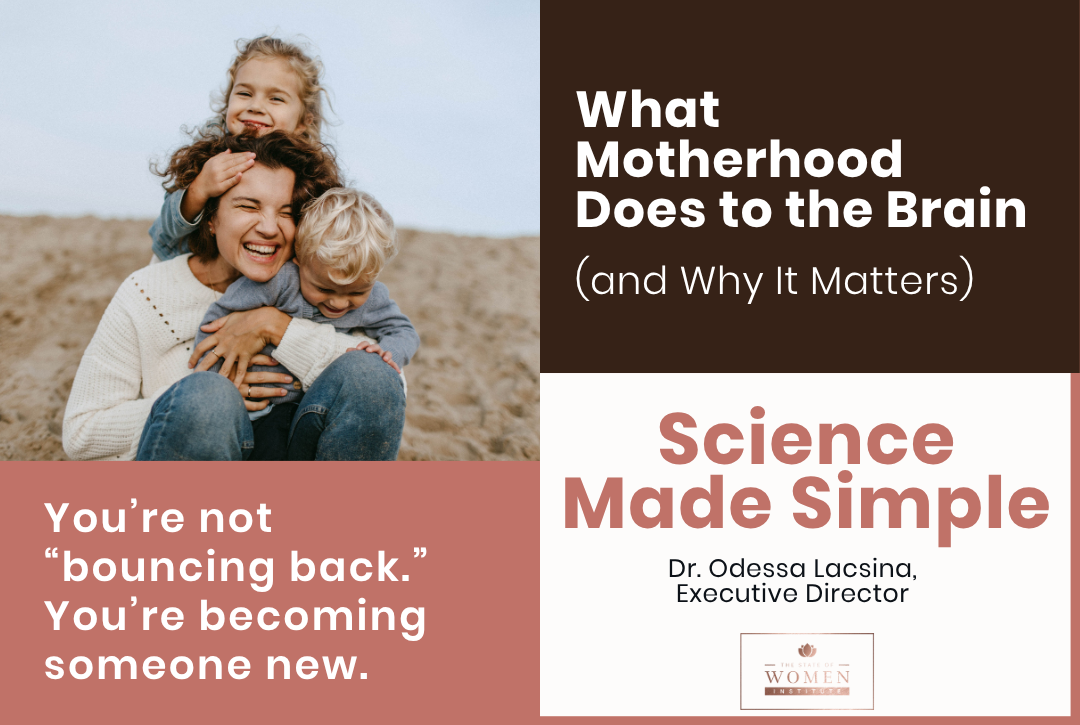
Science Made Simple: What Motherhood Does to the Brain (and Why It Matters)
EVIDENCE TO ACTION | Science Made Simple Mother's Day Edition | The State of Women Institute
By Dr. Odessa Lacsina, Executive Director, The State of Women Institute
This Mother's Day, we honor all the ways mothering shows up in our lives.
For those who've given birth. For those raising children not born to them. For those who've lost their mothers too soon. For those who've lost babies they'll never stop loving. For those waiting, hoping, and navigating the complicated terrain of becoming a parent.
And for those who mother in ways the world doesn't always count: aunts, teachers, mentors, chosen family.
Today's science recognizes what many have known all along: motherhood fundamentally changes you. And those changes last a lifetime.
The Research That Changed Everything
A groundbreaking study published in Scientific Reports analyzed brain scans from over 19,000 women aged 45 to 82. Lead researcher Valentina Rotondi and her team, working across multiple European institutions, wanted to answer a question that had never been asked at this scale:
Do the brain changes of motherhood endure for decades?
The answer was unequivocal: Yes.
Mothers showed widely distributed higher gray matter density compared to women who had never given birth, particularly concentrated in the frontal and occipital regions — areas involved in empathy, understanding others' emotions, and processing social information.
Here is what's remarkable: The brain scans were taken decades after these women had given birth. The youngest participant was 45. The oldest was 82. Yet the structural changes remained visible, measurable, and undeniable.
And fathers? No corresponding brain changes were observed. This transformation appears unique to those who carry, birth, and biologically mother children.
The study also found that both mothers and fathers reported a higher sense of life's meaning compared to those without children — but only mothers showed the corresponding structural changes in the brain.¹
What This Means
For years, mothers have described feeling fundamentally different after having children — not just behaviorally, not just emotionally, but in some deeper, harder-to-name way.
"I'm not the same person I was before."
Science now confirms it. The brain has been restructured. And those changes don't fade with time — they become part of who you are, woven into the architecture of your mind.
For Those Who Grieve
We want to acknowledge something important: this research studies those who gave birth and raised children. But mothering — and the love that drives it — exists in many forms.
If you've lost your mother, her impact on your brain is real. The neural pathways formed in childhood, shaped by her care, remain part of you.
If you've lost a child — whether through miscarriage, stillbirth, or after years together — you are a mother. Your body changed. Your brain changed. That transformation doesn't disappear with loss. The love remains, and so does the biological evidence of mothering.
If you're waiting to adopt, fostering, or raising children not born to you, you are mothering. While this particular study focused on biological birth, emerging research suggests that caregiving itself reshapes the brain — that the act of nurturing, of being attuned to a child's needs, creates its own neural adaptations.
The Complexity of Meaning
The researchers found that motherhood was associated with a higher sense of life's meaning. But this finding deserves care.
Meaning isn't a competition. Women without children — by choice or circumstance — live profoundly meaningful lives. The study shows an association, not a judgment.
For some mothers, that meaning comes mixed with struggle, exhaustion, grief, or regret. Motherhood is not universally joyful, and finding it difficult doesn't make you less of a mother or your brain changes less real.
The brain changes are a biological fact. The meaning is personal, complex, and yours to define.
Why This Research Matters
Understanding that the brain undergoes permanent restructuring during motherhood helps explain why postpartum mental health support is so critical. You are not "bouncing back." You are becoming someone new.
For aging and dementia research, these enduring brain changes may offer insights into protective benefits and long-term maternal mental health. For the women who have always said they were changed by motherhood — science now backs them up. This isn't weakness. It's transformation.
Motherhood, in its many forms, leaves an imprint — on the brain, on the body, on the heart, on who you become and who you'll be for the rest of your life.
This Mother's Day, we honor that transformation wherever it appears: in those who've given birth, in those who've adopted or fostered, in those who mother in ways uncounted, and in those who carry both the love and the loss.
The science shows us what mothers have always known: you never go back to who you were before. And maybe that's exactly how it should be.
To all the mothers, in all the ways that word can mean: We see you.
Source
¹ Rotondi, V., et al. "Enduring maternal brain changes and their role in mediating motherhood's impact on well-being." Scientific Reports, Vol. 14, July 18, 2024. https://doi.org/10.1038/s41598-024-67316-y
Study population: 19,043 women and 17,612 men aged 45–82, drawn from the UK Biobank.
Dr. Odessa Lacsina is the Executive Director of The State of Women Institute, a 501(c)(3) nonprofit working across three health equity pillars: Mental Health & Wellness, Maternal Health Equity, and Preventive Wellness.
To learn more or support women's health leadership, visit thestateofwomen.org or follow @thestateofwomen.
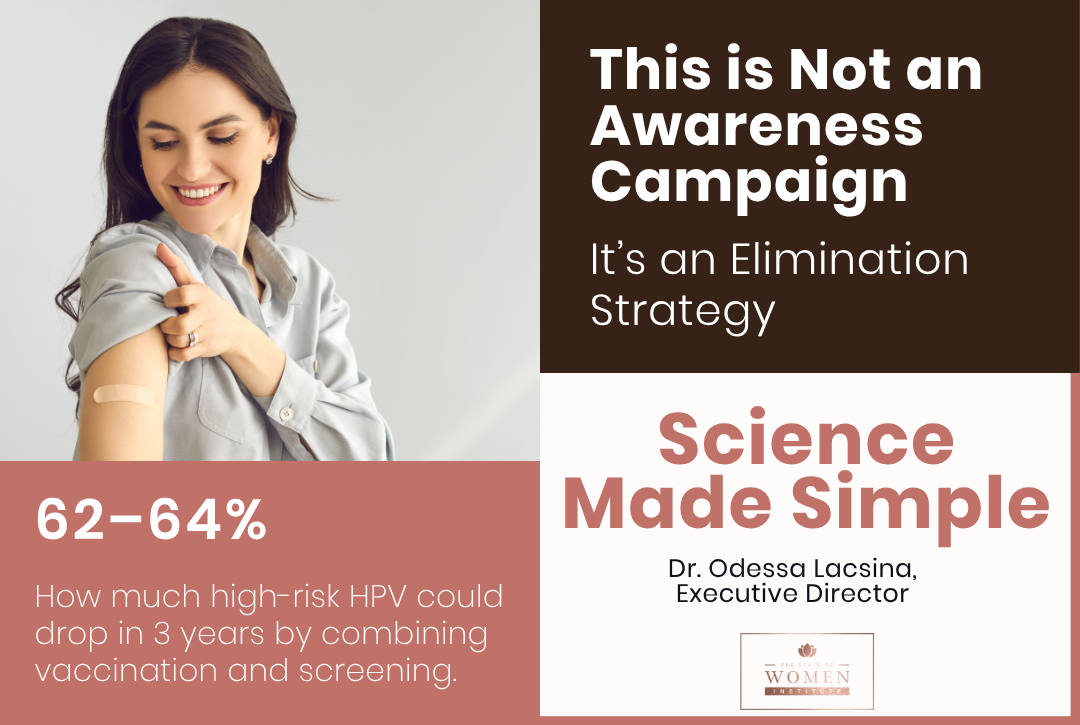
Science Made Simple: This Is Not an Awareness Campaign. It Is an Elimination Strategy.
EVIDENCE TO ACTION | Science Made Simple Special Edition | International HPV Awareness Day | March 4, 2026
By Dr. Odessa Lacsina, Executive Director, The State of Women Institute
I am writing this from Guyana.
Being here — meeting women for whom cervical cancer screening will be accessible for the very first time — makes this research personal in a way that no amount of reading could. The science is ready. The will is building. And the work is happening right now, in real time, in communities that have waited long enough.
Every March 4, the world observes International HPV Awareness Day. Most campaigns ask us to raise awareness. We are asking something different: to raise our expectations.
Cervical cancer is preventable. We have the tools — HPV vaccination and organized screening. What we have lacked is the will to deploy them together, equitably, and at scale. A landmark study published in Nature Communications changes the conversation — not from ignorance to awareness, but from awareness to infrastructure.
This edition of Science Made Simple breaks down what the research shows, what it means for you, and what it demands from our systems. Because the science is no longer the barrier.
The Study That Changes What Elimination Means
In 2021, researchers in Stockholm did something straightforward that turned out to be quietly radical. Led by Arroyo Mühr and colleagues, the team sent an invitation to every woman in the region born between 1994 and 1999 — all 89,547 of them — and made them an offer: come in once, get your HPV vaccine and your cervical screening done at the same visit, and go home.
No separate appointments. No choosing one or the other. Both, together, in a single visit.
The scientific term for this approach is a concomitant strategy — doing two interventions simultaneously rather than sequentially. But the underlying question was simpler than the terminology: is doing both at once actually faster at getting us to elimination than doing either one alone?
Of the nearly 90,000 women invited, 26,125 — just under 30 percent — enrolled between 2021 and 2022. What the researchers found when they modeled the data was striking.
In the cohorts that had already been offered the HPV vaccine years earlier, two of the most dangerous strains — HPV16 and HPV18 — had already declined significantly. That was vaccination doing its job over time. But vaccination has an inherent limitation: it takes decades for a vaccinated generation to age through the window of risk. In the meantime, HPV keeps circulating among people who were never vaccinated.
Screening addresses a different part of the problem. It doesn't prevent infection — but it catches what's already there, identifying abnormal cells before they can become cancer. The catch is that screening has to be repeated, because it can't stop new infections from occurring.
Put the two together, though, and something different happens. The model predicted a 62 to 64 percent reduction in high-risk HPV infections within just three years of implementing the combined strategy. Not decades. Three years. The researchers described it as a compounding public health effect — each intervention amplifying the other in ways that neither could achieve alone, producing what the study called near-complete protection when both were combined.
The conclusion Arroyo Mühr and her colleagues drew was direct:
*"Concomitant HPV vaccination and HPV screening appears to be a realistic option for faster cervical cancer elimination."*¹
Not aspirational. Not theoretical. Realistic — with the right infrastructure behind it.
Science Made Simple: What This Means in Plain Language
The old message was: Get vaccinated.
That message has saved lives. HPV vaccines are among the most effective cancer prevention tools ever developed. But vaccination alone has a time problem — it takes decades for a vaccinated generation to grow up, and in the meantime, HPV keeps spreading among adults who were never vaccinated.
The new message is: Vaccinate AND screen. At the same time. For everyone.
Screening has something vaccination doesn't: speed. Once a woman is screened, the benefit is immediate — abnormal cells can be found and treated before they become cancer. Combined with vaccination, you get short-term protection from screening and long-term elimination from vaccination. The two tools work differently, and that's precisely why they work better together.
Why Together Is Not Just Better — It's Transformational
Think of it this way:
Vaccination stops future infections from taking hold.
Screening catches current infections before they become cancer.
When you do both — you stop what's coming AND address what's already here.
That is how you move from management to elimination.
Why Black and Brown Women Need This Most
The benefits of this combined strategy are not distributed equally — and neither are the harms when systems fail to implement it.
In the United States, Black women are significantly more likely to be diagnosed with cervical cancer at advanced stages and to die from the disease — not because of biology, but because of systemic disparities in access to both vaccination and screening.
According to the CDC, only 38% of Black women have received the HPV vaccine, compared to 48% of white women.² Hispanic women face even greater barriers, with many reporting they didn't know they needed screening at all. These are not knowledge failures. They are infrastructure failures.
What the disparity looks like:
Black women are twice as likely to die from cervical cancer as white women²
Hispanic women have the highest cervical cancer incidence rate of any racial or ethnic group in the U.S.²
Women without health insurance report 7x more difficulty accessing cervical cancer screening²
Knowledge gaps about HPV and its link to cancer are significantly higher among Black and Hispanic populations²
The combined vaccination and screening strategy is especially critical in underserved communities — where neither tool alone has been delivered consistently
Six Things Every Woman Should Know
1. You can get vaccinated as an adult. The HPV vaccine is approved through age 45. If you were never vaccinated, or didn't complete the series, talk to your provider. It is not too late.
2. Vaccination and screening are not either/or. Getting the vaccine does not mean you can skip your Pap smear or HPV test. This research confirms that doing both is significantly more protective than either alone.¹
3. Self-collection is now an option. In many settings — including the Guyana HPV Elimination Initiative — women can collect their own cervical sample for HPV testing. This removes one of the biggest barriers to screening: access to a clinic.
4. Your birth year matters. Women born before widespread vaccination was available — particularly those born before the late 1990s — may not have vaccine protection, and are the exact population this study targets for the concomitant strategy.¹
5. Ask your provider specifically. Don't just ask if you are "up to date." Ask: Have I been tested for high-risk HPV strains? Have I been offered vaccination? What screening interval is right for my age and history?
6. This is about systems, not just personal choices. The most important thing you can do is demand that your healthcare system, your employer, and your elected officials invest in making both vaccination and screening universally accessible — not just available to those who can afford it.
"The science is no longer the barrier. This initiative is how we build effective systems." — Dr. Odessa Lacsina, Executive Director, The State of Women Institute
Take Action: Three Steps This Week
Step 1 — Know Your Status
Call your provider and ask: When was my last HPV screening? Have I been tested for high-risk HPV strains?
If you haven't been screened in the past 3–5 years, schedule an appointment this week
Ask about self-collection options if a clinic visit is a barrier for you
Step 2 — Protect Yourself and the People You Love
Share this post with one woman in your life who may not have been vaccinated or screened recently
If you have a daughter, niece, or young woman in your community — make sure she knows the HPV vaccine is recommended starting at age 9
The vaccine works best before exposure, but it has benefit at any age through 45
Step 3 — Demand Infrastructure
Contact your local health department or elected representative and ask what cervical cancer screening programs exist in your community
Support organizations — including The State of Women — that are building the delivery systems this research calls for
Follow the Guyana HPV Elimination Initiative for real-time updates on what elimination looks like in practice
Cervical cancer is preventable. Elimination is possible: Where women's voices build the systems that sustain their health.
Evidence to Action | The State of Women Institute | thestateofwomen.org
Sources
¹ Arroyo Mühr LS, Gini A, Yilmaz E, Hassan SS, et al. "Concomitant human papillomavirus (HPV) vaccination and screening for elimination of HPV and cervical cancer." Nature Communications, Vol. 15, Article 3679, May 1, 2024. https://doi.org/10.1038/s41467-024-47909-x
² Centers for Disease Control and Prevention. HPV Vaccination Coverage and Cervical Cancer Disparities Data. https://www.cdc.gov/hpv
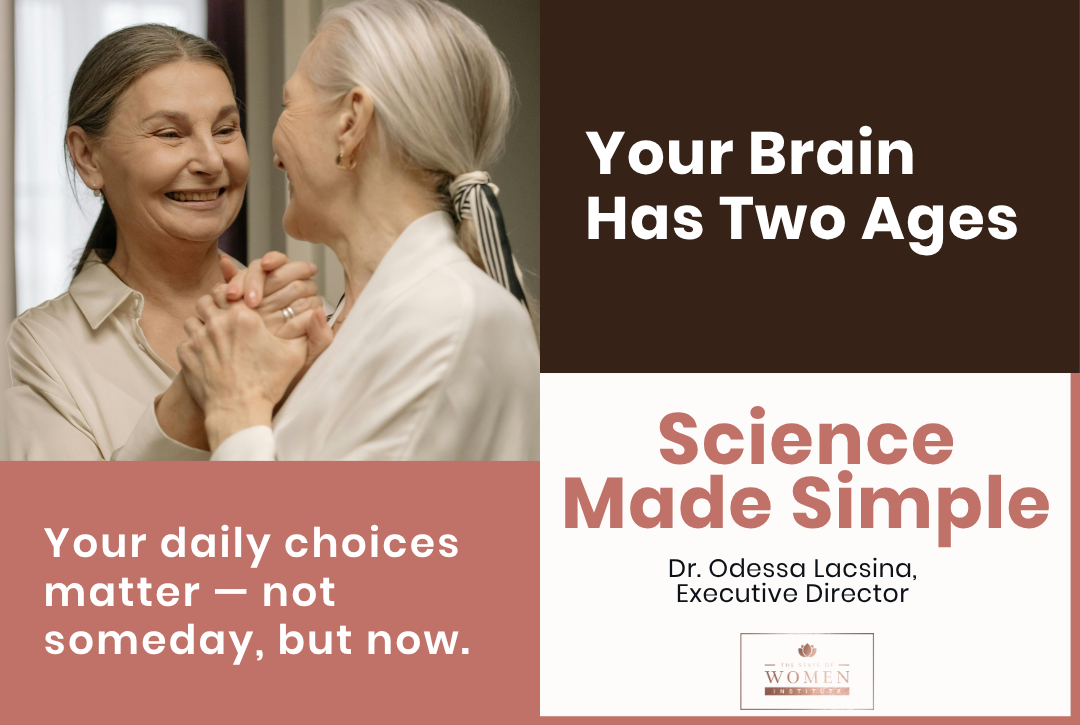
Science Made Simple: Your Brain Has Two Ages
EVIDENCE TO ACTION | Science Made Simple The State of Women Institute
By Dr. Odessa Lacsina, Executive Director, The State of Women Institute
Your driver's license says you're 55. But your brain? It could be living its best 47-year-old life — or, less encouragingly, acting more like it's 63.
New research out of the University of Florida reveals something genuinely surprising: your brain has two ages. The first is your chronological age — how many birthdays you've had. The second is your brain age — how your brain actually looks on an MRI scan. And here's what makes this research worth paying attention to: you get to influence which one matters more.
The Eight-Year Finding
Scientists at the University of Florida tracked 128 adults over two years and found that people with the healthiest lifestyle habits had brains that appeared up to eight years younger than their chronological age — and that their brains also aged more slowly over time, meaning the benefits kept accumulating.
Eight years. That is not a rounding error. That is a measurable, structural difference in how a brain looks on a scan, driven not by medication or medical intervention, but by daily habits.
Lead researcher Dr. Jared Tanner and his team, publishing in Brain Communications in December 2025, identified seven specific habits associated with younger-looking brains. None of them are exotic. All of them are within reach.¹
The Seven Habits
Quality sleep — not just time in bed, but actual restorative sleep
Optimism — which, the research suggests, can be practiced and cultivated
Social support — having people you can genuinely lean on
Stress management — developing the capacity to handle life's inevitable chaos
Healthy waist circumference — maintaining weight in a healthy range
No tobacco use
Positive mindset — focusing on what you can influence and control
Each habit adds another layer of protection. Critically, they work together — the benefits compound rather than simply adding up.
Why This Matters — Especially for Women
An older-looking brain is more vulnerable to memory decline, dementia, and Alzheimer's disease. And women are already at higher risk for Alzheimer's than men — making research like this particularly urgent, and particularly relevant to the health equity work at The State of Women Institute.
But here is what this research makes clear: we are not without agency. We have tools. The daily choices that shape brain health are not reserved for people with access to expensive interventions. They are, for most women, already within reach — and the evidence now tells us they matter more than we may have realized.
It's Never Too Late
One of the most important findings in this study: even people living with chronic pain — who typically show accelerated brain aging — saw protective benefits from healthy habits. The biology is not fixed. The brain responds.
Lifestyle is medicine. Your daily choices matter — not someday, but now. And you don't need to be perfect. Every small improvement counts, and the research suggests those improvements stack.
The Bottom Line
Your brain age is not set in stone. It is moldable, changeable, and responsive to the way you live. Sleep well. Stay hopeful. Stay connected. Find ways to manage stress that actually work for you.
The science is telling us something we can act on. That's the whole point of this series.
What is one habit you're going to focus on this week?
Source
¹ Tanner, J., et al. Brain Communications, December 2025. University of Florida.
Dr. Odessa Lacsina is the Executive Director of The State of Women Institute, a 501(c)(3) nonprofit working across three health equity pillars: Mental Health & Wellness, Maternal Health Equity, and Preventive Wellness.
To learn more or support women's health leadership, visitthestateofwomen.org or follow @thestateofwomen.